SEObot vs. SEO Receipts: Automation or an Evidence-Backed Queue?
Quick answer: Choose SEObot when you want an automated content system that researches, writes, links, and publishes articles. Choose SEO Receipts when you want to review recommendations from verified Search Console and crawl evidence, approve the next task yourself, and measure the traffic window after a change ships.
A founder can lose a week writing one article or wake up to nine generated ones and wonder whether any should exist. SEObot and SEO Receipts sit on opposite sides of that tradeoff: production volume versus controlled prioritization.
Neither approach is automatically better. The right choice depends on whether your current constraint is producing content or deciding which change has enough evidence to deserve work.

SEO GROWTH
SEObot vs. SEO Receipts: Automation or an Evidence-Backed Queue?
PRIMARY KEYWORD
SEObot vs SEO Receipts
READ TIME
8 minutes
What does SEObot automate that SEO Receipts does not?
SEObot says it researches a site, audience, and keywords, creates a content plan, writes articles, adds internal links, and publishes through supported CMS integrations. Owners can approve, decline, moderate, or leave the workflow on autopilot. That is a content production system.
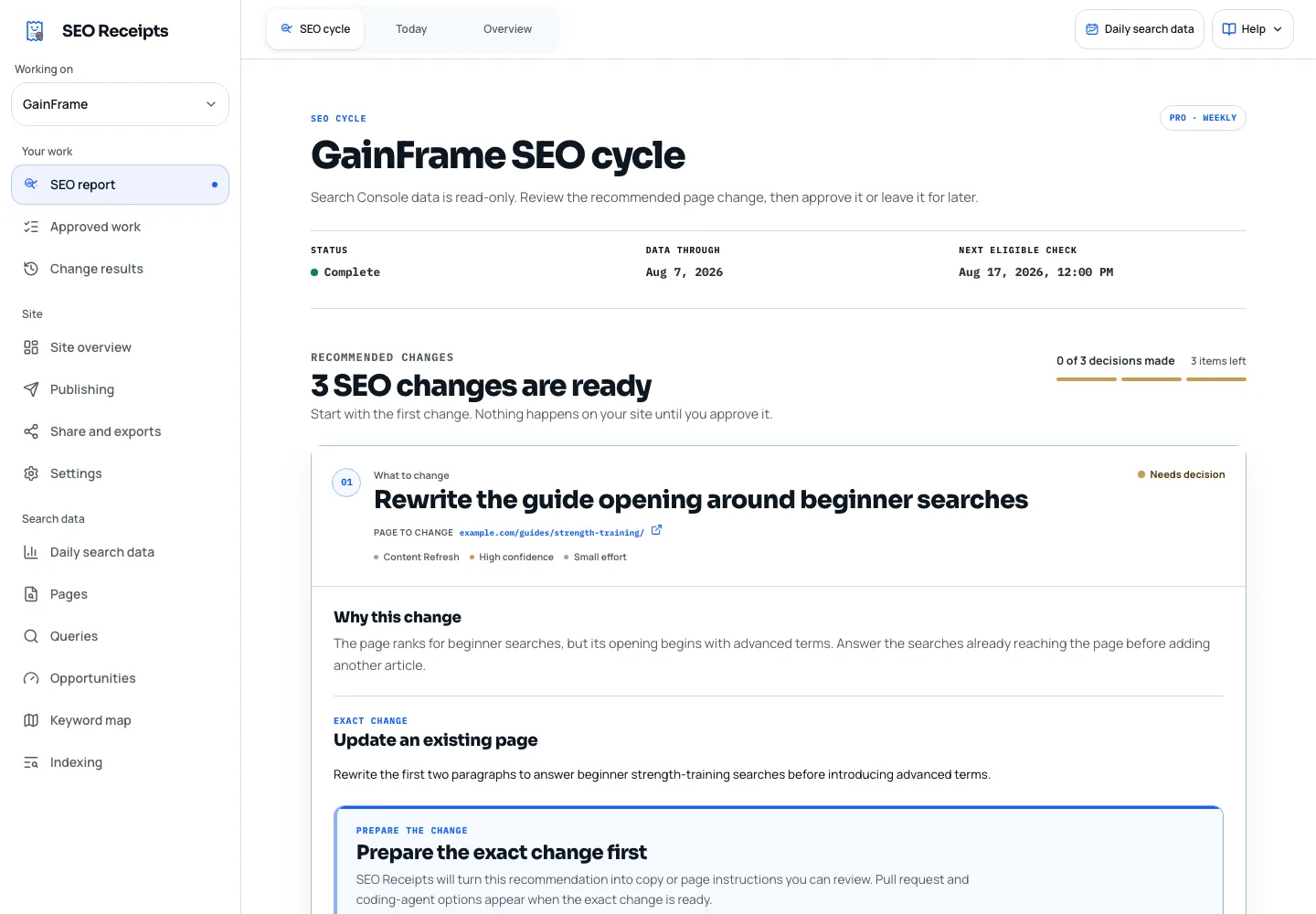
SEO Receipts does not run a bulk publishing engine. It analyzes measured performance, watched queries, index evidence, speed signals, and bounded crawl findings. You approve recommendations before they become tasks, and the product keeps the current action visible rather than creating an open-ended publishing calendar.
How much do SEObot and SEO Receipts cost?
SEObot's official help center lists $49 per month for nine articles, $99 for twenty, and higher tiers that scale to hundreds of articles. Its homepage describes research, writing, internal linking, images, and publishing inside that output.
SEO Receipts Free includes one complete audit. Pro is $9 per month for weekly cycles and up to ten sites. Growth is $29 per month for daily cycles, larger checks, and additional evidence access. The cheaper product also performs a narrower job, so price should follow the workflow you need.
Which approach creates more editorial risk?
More automated output creates more review responsibility. SEObot itself says article quality can vary by audience, topic, and requirements. A human still needs to verify facts, remove repetition, confirm the search intent, and decide whether the page adds something a reader cannot get elsewhere.
SEO Receipts reduces publishing volume by requiring approval, but it cannot guarantee that an approved action will improve rankings. Its advantage is traceability: the task cites the stored evidence that caused it to appear, and the later measurement window preserves what happened without claiming causation.
Can you use SEObot and SEO Receipts together?
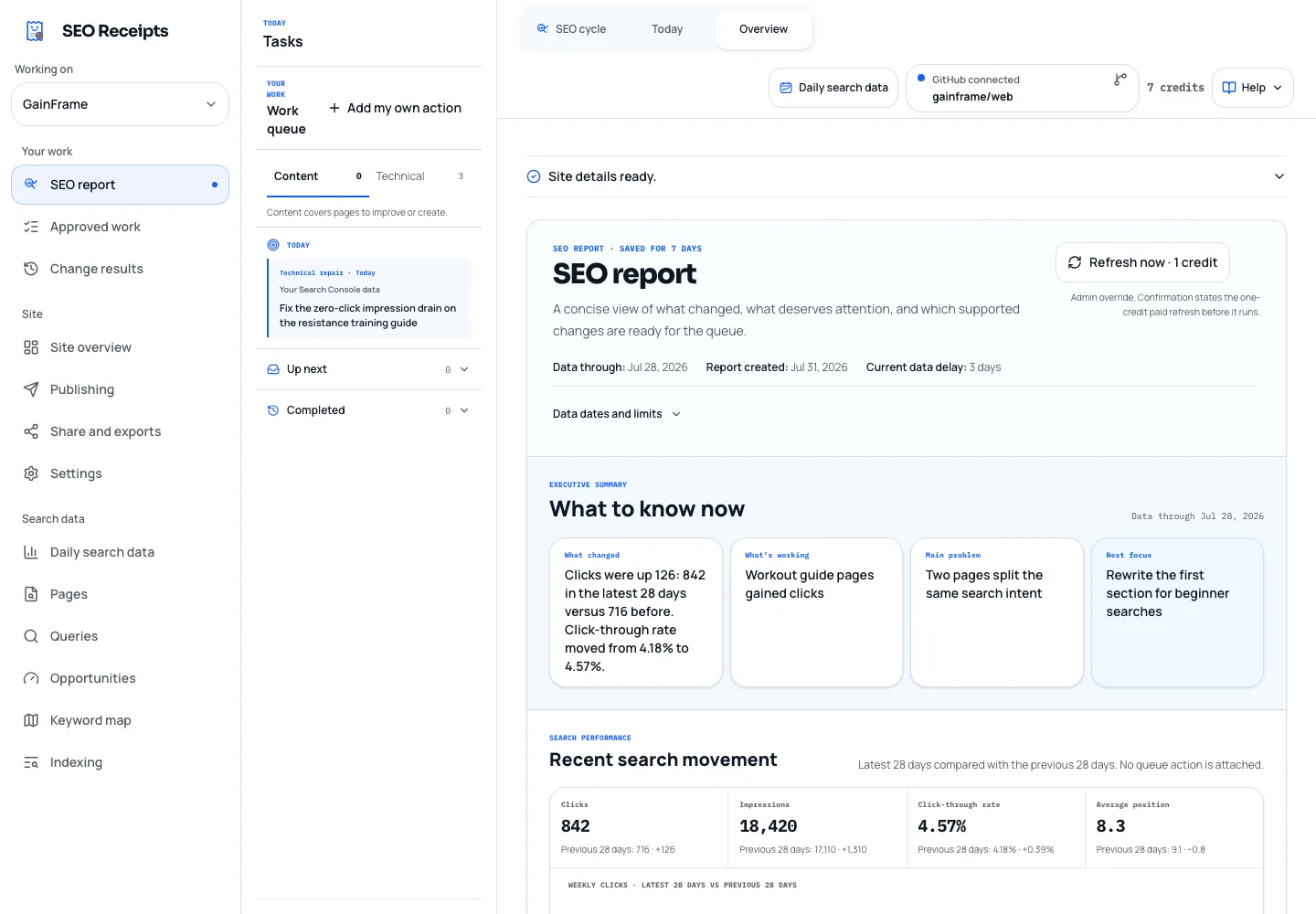
Yes, if you define the boundary. SEObot can produce drafts or manage a content calendar. SEO Receipts can monitor how published pages perform in Search Console and surface evidence-backed follow-up work. Do not let one tool's production count become the other tool's success metric.
Record each publication date, preserve the target query and page, and judge the result after Google has had time to crawl, index, and serve it. Search Console reports measured impressions and clicks, but it does not prove that one automation caused them.
Practical checklist
What belongs on the decide whether content automation is your bottleneck?
- 01Count how many reviewed, useful articles you shipped in the last ninety days.
- 02Measure editing time as well as generation time.
- 03Choose three pages where demand is already visible in Search Console.
- 04Test the content system on those pages before enabling autopilot.
- 05Record publication dates and the evidence behind each topic.
- 06Keep or cancel the tool based on reviewed output and measured traffic, not draft volume.
What else do people ask about SEObot vs SEO Receipts?
Does SEObot publish articles automatically?
Yes. Its official site describes an autopilot workflow with CMS integrations, while also allowing owners to approve, decline, moderate, and edit articles. Review controls exist, but you must choose to use them consistently.
Does SEO Receipts write blog posts automatically?
No. It can prepare bounded outputs for approved Workbench actions, but it does not operate an autonomous content calendar or publish unchecked articles to your CMS. The owner remains responsible for execution and approval.
Is automated SEO content against Google's rules?
Google targets scaled content abuse when pages are produced primarily to manipulate rankings and provide little value. The tool alone is not the test. Review, originality, factual accuracy, and usefulness still determine whether automated production becomes a liability.
Which tool is better for a solo SaaS founder?
Choose SEObot if consistent content production is clearly the constraint and you will review its work. Choose SEO Receipts if the site already has traffic and your problem is choosing, shipping, and measuring the next defensible SEO action.
Which primary sources support this guide?
These primary sources explain the product behavior and metric definitions used in this guide. Reviewed on August 23, 2026.
- 01SEObot product and workflow
SEObot's official description of automated research, writing, internal linking, and publishing.
- 02SEObot subscription pricing
SEObot's official article volumes and monthly subscription prices.
- 03SEO Receipts plans and product details
Current Free, Pro, and Growth plan capabilities and prices.
- 04Google Search Console Performance report
Google's definitions for the measured search data used throughout these comparisons.
SEO FOR ONE SERIOUS WEBSITE
Turn your own Search Console data into the next action.
Run a complete evidence-backed audit for free. Upgrade only when you are ready to prepare actions, ship changes, and measure what happens next.